Shopify AI Customer Support. How AI Helps Ecommerce Stores Scale Faster
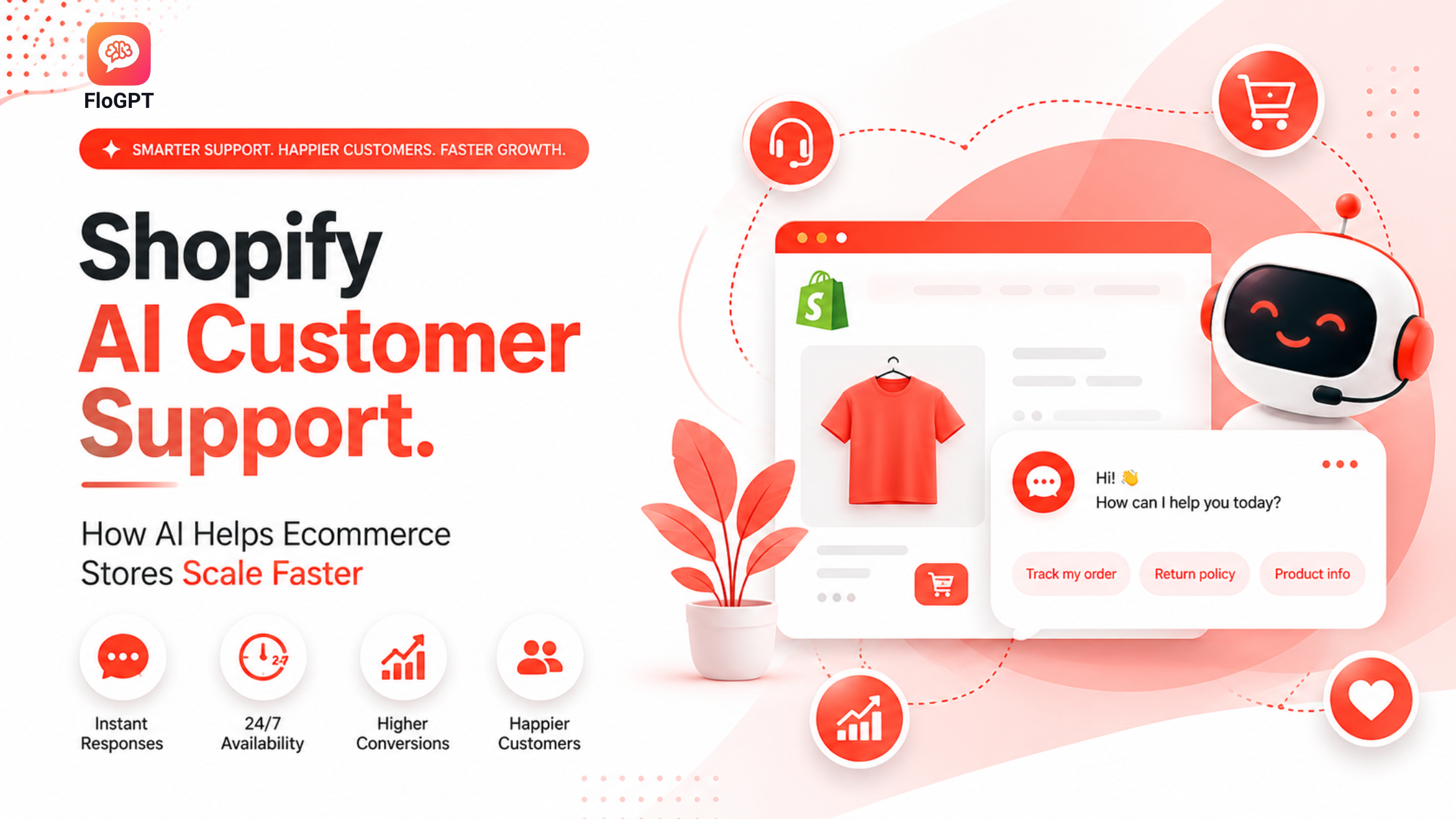
Understand how Shopify AI Customer Support helps e-commerce stores automate conversations with customers, speed up responses, convert sales, and boost customers' experiences with FloGPT.
When you're running a Shopify store, it can feel like you're answering the same questions, over and over:
"Where's my order?"
"Do you ship internationally?"
"Can I return this?"
At first, you can handle it. And then your business scales. Your inbox, live chat and support queue are suddenly on fire.
The easiest solution is to hire another support agent, right?
But what if AI could be a smarter solution?
More Shopify merchants are turning to Shopify AI Customer Support solutions to help them scale, not replace their human agents.
The Hidden Cost of Slow Customer Support
Most online shops concentrate their efforts on gaining traffic.
They invest on advertisements, SEO, influencers and email marketing.
However, a majority of online stores loses customers after they arrived on their websites.
Why is it the case?
Simply because shoppers want the immediate response to their queries.
If your client is unable to rapidly retrieve shipping information, return policies or even product specifications, you can be certain they will be more tempted to go buy from one of your rivals.
It's actually really simple:
Every unsolved question is an opportunity for a lost sale.
Why Traditional Support Doesn't Scale
And as your Shopify store gets bigger, so will the number of support inquiries you're dealing with.
More orders equal more customer questions.
More products equal more questions about specific items.
More traffic equals more conversations.
But there's a problem. Unlike your online store, it's not as easy to scale a team of human agents.
Bringing on additional agents leads to:
- Higher expense
- More training time
- Increased management burden
- Inconsistent responses
This is where AI Customer Support will flip the game around.
What Shopify AI Customer Support Actually Does
Lots of us still picture AI-powered customer support as a frustrating, robotic chatbot.
The new way of working is far more sophisticated.
A successful AI Customer Support system for Shopify will understand what a customer is asking for, use the store data available, and provide relevant information in real time.
A customer might ask:
- 'Where is my order?'
- 'What is your returns policy?'
- 'Is product X currently in stock?'
- 'How long does shipping usually take?'
- 'Which product should I buy?'
They get instant answers rather than having to wait to speak to an agent, which benefits both the customer and your team.
The Best Support Happens Before a Ticket Is Created
Biggest misunderstanding around customer support is that it begins after a customer has an issue.
However, in reality, top customer support is something that pre-empts an issue.
When it's easy for a customer to find solutions they don't have a reason to submit a ticket.
When they have clear guidelines they do not leave the cart unattended.
When they have peace of mind they complete a purchase.
AI is not just a customer support tool
AI is a conversion tool.
How FloGPT Helps Shopify Stores
FloGPT was created to make it possible for businesses to have automated conversations with customers while ensuring these interactions don't seem impersonal or like the person they are speaking with is a robot.
With FloGPT's Shopify AI Customer Support feature, retailers can give their customers round-the-clock instant support.
Instead of having generic answers to their questions, FloGPT will be able to draw from your company's knowledge base, policies, FAQS, and product information.
Customers will have up-to-date answers at the tips of their fingers. No more hours later. No more the next business day. Right now.
More Than Just a Chatbot
Another differentiating factor that sets FloGPT apart from simple support widgets is that it’s a holistic customer communications tool. Companies can integrate:
- AI Chat Agents
- AI Voice Agents
- Knowledge Base AI
- CRM
- Workflow automation
All within one integrated platform, resulting in an integrated support channel and not yet another disjointed tool.
AI Support That Learns Your Business
No two Shopify stores are alike.
A fashion brand doesn't get the same questions as a supplement company.
A furniture store doesn't have the same support issues as a makeup retailer.
Generic chatbots simply don't cut it.
With FloGPT, businesses can create AI support based on their own content, policies, products and process. This leads to a support experience that is much more pertinent to customers.
What Customers Actually Want
Most people don't want superhuman help.
They just want to get answers quickly. They want them to be correct. They want the experience without the queue.
AI Customer Support provides that very thing. Not with 100% human replacement, but by taking on all the recurring questions, allowing humans to deal with more complex, nuanced conversations.
The Future of Shopify Customer Support
Customer expectations aren't going to stop evolving, they'll continue to grow.
Customers are going to demand instant access to your brand whether you're there 24/7, after hours, or on weekends.
This is an advantage and a challenge for a Shopify merchant.
The businesses who can provide better, faster support than the other will have an advantage, and AI can be one of the easiest ways to offer it.
Final Thoughts
The objective of customer service isn't to resolve customer questions.
It's to build trust.
When customers know that they're going to be met with quick answers to questions, they become confident. And when a customer is confident, they are likely to buy from you, convert at a higher rate and return for more business.
And it's why Shopify AI Customer Support is an integral part of ecommerce today.
FloGPT empowers merchants to automate conversations, decrease support loads and enable quicker, faster service- all without adding complexity to their existing workflow.
Because often, the smartest way to scale isn't to add more people to the equation.
It's to give your customers the answers that they are already trying to find.